When writers say “craft books,” we’re talking about books on the craft of writing. I’ve never read a craft book that I agreed with from the first line to the last, and I think that’s okay. Sometimes, in fact, encountering advice that you absolutely disagree with is valuable. It’s an opportunity to ask, “why do I disagree with this so vehemently?” And so, you test and refine your thinking. The following are books that have been useful to me as a young writer.
- Elements of Style, Strunk and White.
This one I recommend with reservation. This book is useful, but you almost need a special course in grammar to understand it. Even I, a graduate student in English and an instructor in creative writing, have to read some of the items in this book repeatedly to understand what they are saying and why they are saying it.
I was never a great student in grade school, and I don’t remember much from my early lessons on English grammar. But I also don’t believe American schools teach grammar the way they used to. (I’m not lamenting this, I’m just saying.)
So, I recommend Elements of Style, strongly, for any serious—or self-serious—writer. But if you pick it up and feel stupid while trying to remember what a participle is, or trying to remember what makes a clause restrictive vs. nonrestrictive, don’t beat yourself up. Grammar is difficult because, if you’re a native speaker or if you’ve been speaking the language a long time, you don’t have to think about it. So when you do start thinking about it, it’s confusing. That’s normal. My recommendation is to read Elements of Style slowly, read it repeatedly, and if you only absorb half of it, that’s fine.
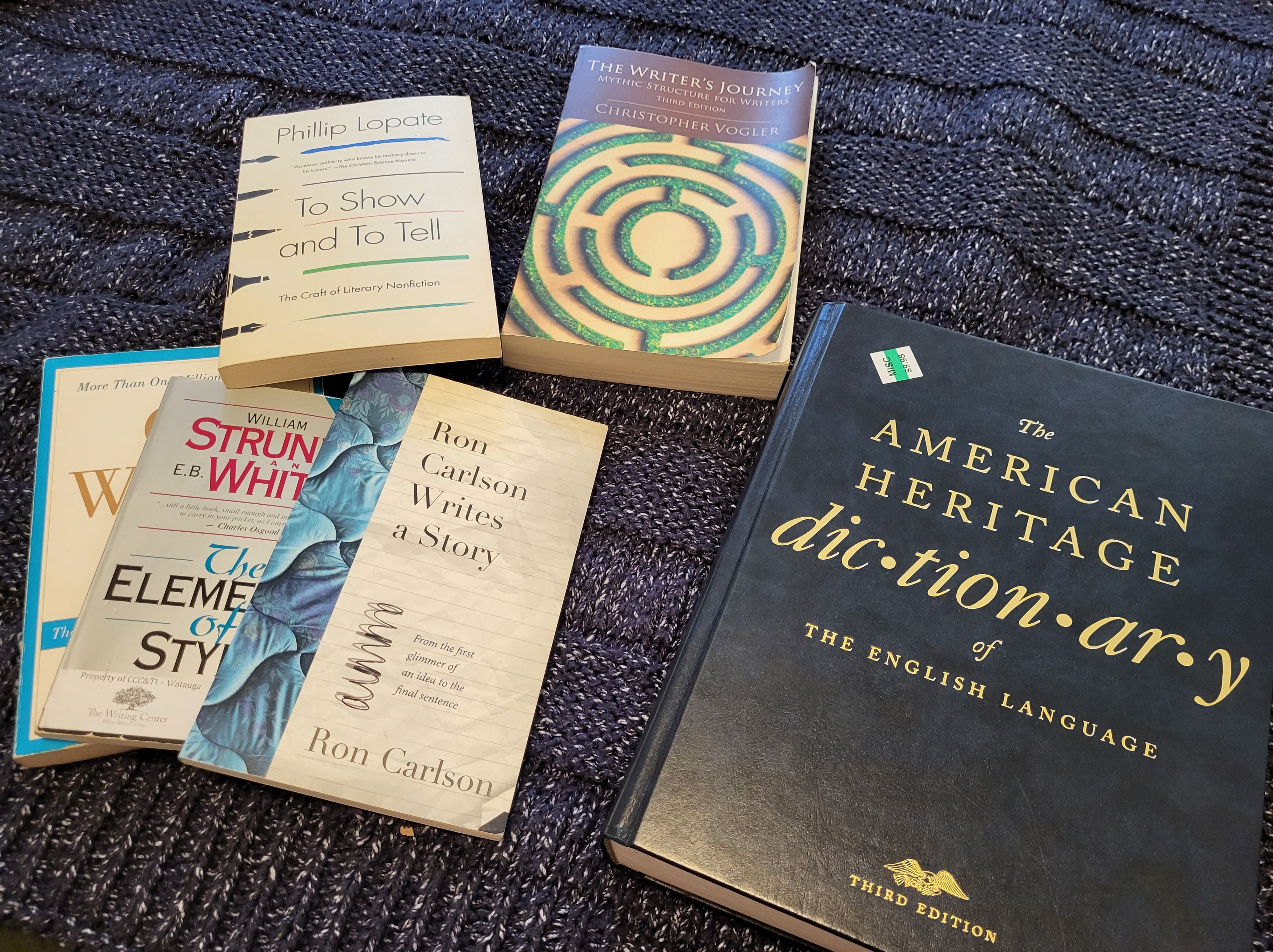
- On Writing Well, William Zinsser.
I recommend this one with reservation, too. It’s a bit old-fashioned, and yet, there’s good advice here about prose, about how to structure a nonfiction piece, about how to conduct an interview. It’s occasionally very funny. Again, some of it, like the section on travel writing, is totally outdated. But even in that section, there are some good suggestions.
- The Writer’s Journey, Christopher Vogel.
I have a special love for this one. Most craft books give you guidelines about prose style (I think of Stephen King’s On Writing, with its caution against adverbs). The Writer’s Journey isn’t about prose at all, it is about storytelling. Even if you don’t agree with everything in The Writer’s Journey, even if you don’t want to follow the formula of the hero’s journey (even if you object to it), I recommend this book.
Most writers, and many MFA students, don’t need instruction on writing good prose. I mean, it doesn’t hurt. But what we really need is discussion of storytelling. Where do you begin? What makes an ending gratifying? Most professors, when faced with these questions, throw up their hands and say, “You’ll probably just have to write a lot to figure out what the story is.” And that’s true! But I find this unwillingness to say what a story is, or how a story should work, totally unsatisfying. Books that make pronouncements about story are valuable, and this one is my favorite. Vogler also explains the etymology of many words related to story and in doing so draws connections between storytelling and life.
- Wired for Story, Lisa Cron.
This is another that discusses the shapes of stories explicitly. I don’t agree with every dictum Lisa Cron gives in this book, but many of them are golden. She says to start a story when a clock starts ticking, and then makes up an example story to illustrate her point. This book, combined with the Writer’s Journey, helped me understand story structure and develop my own model.
- Ron Carlson Writes a Story.
Partly recommended for brevity. Good advice in this one too. Carlson suggests that after you get two thirds of the way through your story, you should introduce no new characters or inventory. In practice, there is flexibility with this rule, but it makes a great guideline.
- To Show and To Tell, Phillip Lopate
I recommend this because Phillip Lopate is my favorite living (is he still alive?) prose stylist. He’s sharp as a tack. This book is a guide to nonfiction writing, and a challenge to the often-heard dictum “Show don’t tell.” I saw Phillip Lopate speak at NYU. It was love at first listen, if not love at first sight.
- Honorable Mention: Bird by Bird, Anne Lamott.
I admit, I don’t love this book. It’s not that it’s bad: Bird by Bird is better than many craft books. I just found much of the writing advice to be a bit abstract (for example, “Train your broccoli to eat itself.”) That said, a different writer might find this book extremely useful and encouraging. There is also advice in this book I haven’t seen anywhere else, such as how to deal with jealousy, that emotion all writers face now and then.
Do you love a craft book I left off the list? Let me know in the comments and don’t forget to subscribe.
 Nolancapps.com
Leave a comment